Optimum Security installed a security app on their website, and it blocked Google from indexing every page on the site. Their content, reviews and links stopped counting, because Google couldn't see any of them. Once the block was removed, their traffic came back.
That story is the simplest way I know to explain SEO. It's five jobs, and they have an order. I run Brandcamp Digital, a digital marketing agency in Vancouver, and this is the framework I use to explain and plan SEO for our clients.
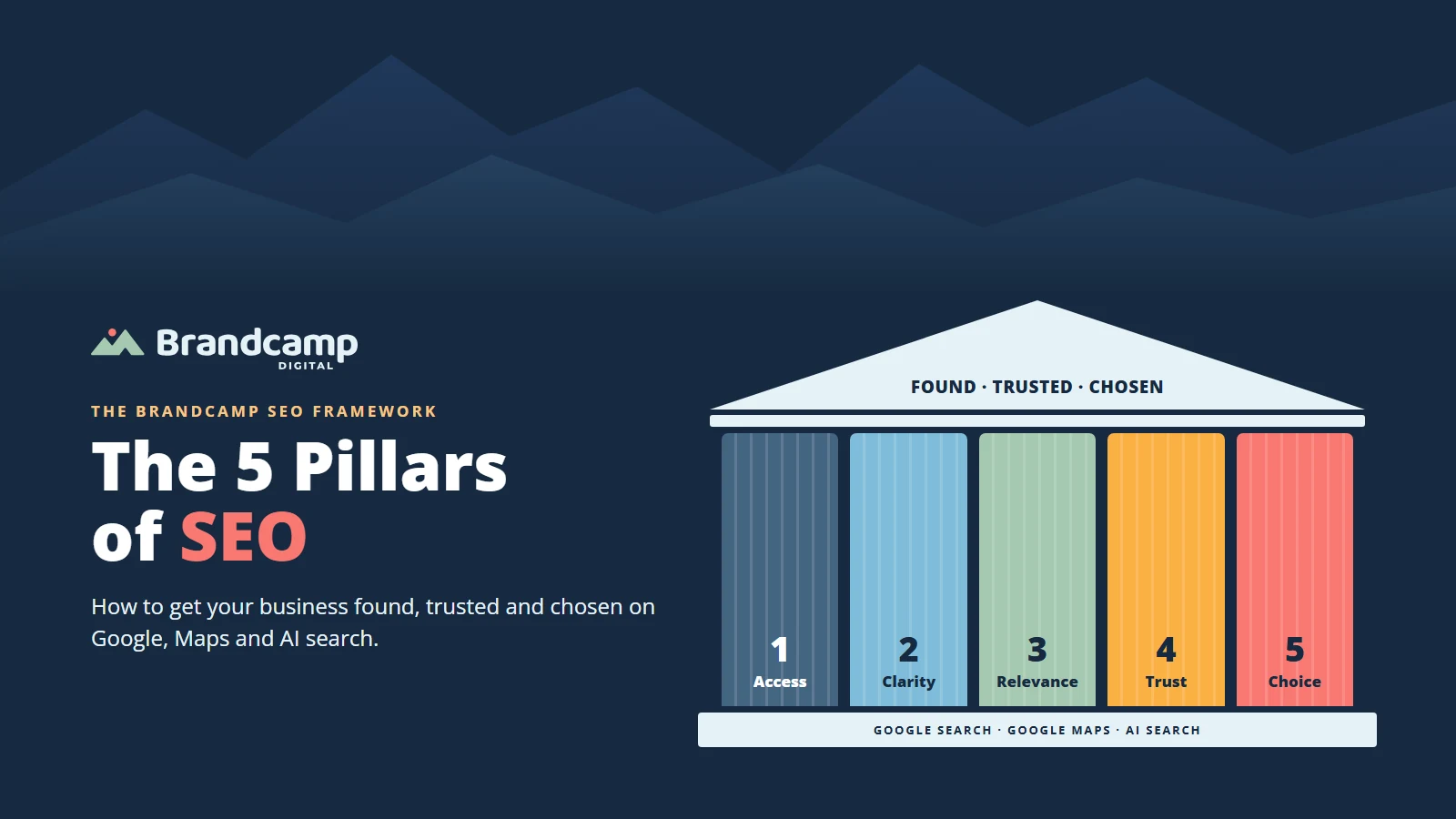
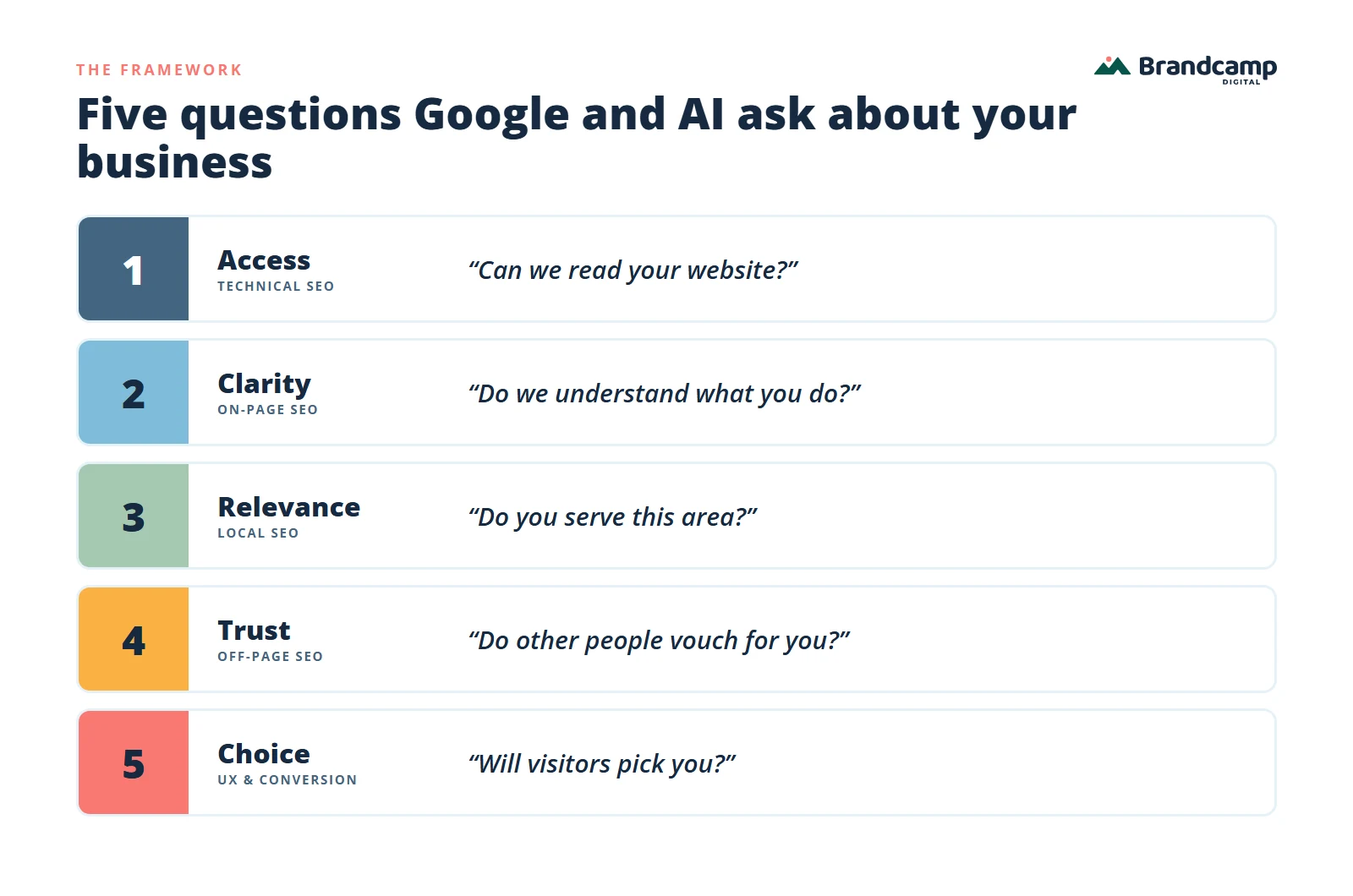
- SEO comes down to five pillars: Access, Clarity, Relevance, Trust and Choice. Each one answers a question Google and AI tools ask about your business.
- The order matters. Optimum Security's site was invisible to Google until Access was fixed, and nothing else could help until then.
- Pro Works Painting's clicks are up 70% year over year, with 27 search terms moved to page 1 of Google.
- AI search isn't a sixth pillar, because it runs on the same five. Blue Grouse Wine Cellars, an SEO client of ours, was cited in 4,342 US and 2,287 Canadian Google AI answers in three months.

SEO means being found, trusted and chosen where your customers search
SEO is making sure that when someone searches for what you do, where you do it, they find you, trust you and choose you, on Google, on Google Maps and in AI answers.
That definition has three parts, and each one does a job. "What you do, where you do it" is the search that turns into a lead. "Find, trust, choose" is the path a customer takes before they call. Google, Maps and AI are the three places that path now starts.
You'll see other agencies list six, 13 or even 40 types of SEO. Most of those lists are accurate, but they don't tell a business owner what to do first or how to tell if it's working. The five pillars do both.
AI search is a newer layer of SEO, not a separate type
I don't treat AI search as its own pillar, because the work that earns AI mentions is the same work that earns Google rankings. ChatGPT, Perplexity and Google's AI Overviews read your website, your Google Business Profile, your reviews and what other sites say about you. Those are the same signals the five pillars build.
Blue Grouse Wine Cellars shows how this plays out. We run SEO for their online store, and over three months Google's AI cited their site in 4,342 answers in the US and 2,287 in Canada.
You might hear it called GEO, or generative engine optimization. I call it AI search optimization, because that's what it is and most of our clients have never heard the word GEO.
Koru Construction shows what a gap looks like. They rank fourth on ChatGPT and show up well on Perplexity for custom homes in Maple Ridge and for laneway and garden suites. They don't show up for renovations or for the Tri-Cities. That gap comes from Clarity and Relevance: the website doesn't clearly cover those services and areas yet. The fix is the same one we'd use for Google, with pages built for those services and places.
Pillar 1, Access: Google has to be able to read your website first
If Google and AI tools can't load, crawl and understand your pages, nothing else you do will count. This is the foundation the other four pillars stand on, and it's the pillar business owners notice least, because a site can look fine to a visitor and still be invisible to Google.
Optimum Security's site looked normal to anyone who visited. The security app was quietly telling search engines to stay out. It's one of the first things we check, along with:
- Pages that are blocked from Google, missing from Google's index or returning errors
- Site speed and Google's Core Web Vitals, especially on phones
- Schema markup, which tells Google and AI exactly what your services, locations and reviews are
- Tracking through GA4, Google Search Console and call and form tracking, so we can measure the other four pillars
How we measure it: pages indexed, Core Web Vitals passing and crawl errors fixed.
Pillar 2, Clarity: every service you offer needs its own clear page
Google and AI can only recommend you for the things your website clearly explains. If your homepage says "we do it all", you'll rank for very little. If each service has its own page that answers what customers actually ask, Google knows exactly when to show you.
For Pro Works Painting, we published nine new guides answering questions their customers search for, and those guides have brought in 128 clicks so far. Across the site, 27 search terms have moved onto page 1 of Google, and clicks are up 70% year over year.
Clarity work includes:
- Keyword research based on how your customers really search, not how your industry talks
- One focused page for each service
- Titles, headings and content that answer real questions
- Writing for people first, then making sure search engines can follow it
How we measure it: rankings for your services, impressions in Google Search Console and mentions in AI answers.
Pillar 3, Relevance: tell Google exactly where you work
Searches for local services usually have a place attached, like a city name or "near me", so Google needs proof of where you work. Your Google Business Profile, location pages and directory listings all give it that proof.
Pro Works Painting's Okanagan location moved into the top 3 on Google. VanCity Physio now ranks first or second across repeated searches within 3 km of both of their clinics.
Relevance work includes:
- A complete, active Google Business Profile for each location
- City pages for the areas you serve, then neighbourhood pages once those are working
- The same business name, address and phone number on every directory
- Photos and reviews tied to the locations you serve
Our Vancouver local SEO checklist goes through this pillar step by step.
How we measure it: map rankings, and calls and direction requests from your Google Business Profile.
Pillar 4, Trust: reviews and mentions are proof, and you can't shortcut them
Google and AI trust the businesses that other people trust, so reviews, mentions and links from respected websites carry a lot of weight. This is also the pillar with the most bad advice around it.
Buying backlinks, black hat link schemes and the newer wave of tools that promise to "trick" AI into recommending you are the same idea with different packaging. They try to fake trust instead of earning it. At best they waste your money. At worst they break Google's spam policies, and your site loses the rankings it had.
What works is slower and simpler:
- Ask happy customers for a Google review, and ask them to mention the service and the city. "They painted our house in Chilliwack" helps more than five stars on their own.
- Publish content other websites want to link to and quote.
- Find mentions you already have, like press coverage or partner listings, and connect them to your site.
- Keep your business details the same everywhere AI tools look you up.
We wrote a full guide on how to get more Google reviews if you want to start there.
How we measure it: review count and rating, websites linking to you and brand mentions.
Pillar 5, Choice: rankings only pay off when visitors call
The first four pillars bring people to your website, and Choice is what turns that visit into a call, booking or quote request. A page that ranks but doesn't convert is a missed lead. We handle this pillar as conversion rate optimization, scoped separately from SEO, so you can add it when your traffic is ready.
After VanCity Physio's new website launched, more of their visitors turned into bookings. By October 29 they had booked 99 new patients for the month, with SEO and Google Ads both running.
Choice work includes:
- A clear next step on every page: call, book or request a quote
- Real project photos and reviews right where people decide
- Short forms and click-to-call on mobile
- Testing and improving the pages that bring in the most traffic
How we measure it: conversion rate, calls, form fills and quote requests.
Work on the pillars in order
Each pillar depends on the one before it, so we fix them in order. Great content on a site Google can't read won't rank. Traffic to a page that doesn't convert won't bring in leads.
I think of it like a good mechanic. When I take my motorcycle in, I want a list: here are the 13 things wrong, here's what's urgent, and here's what I wouldn't bother fixing. Our SEO proposals work the same way. They're itemized by pillar and in priority order, so your budget goes to what will make the biggest difference first.
Every month, our reports show the leads we brought in, where they came from and what they were worth. Each pillar has its own measure, so you can see which part of the work is paying off. If you're wondering about timing, we've written about how long SEO takes to show results.
Check your business against the five pillars
Tick each one you can honestly say yes to, and start with the first blank box.
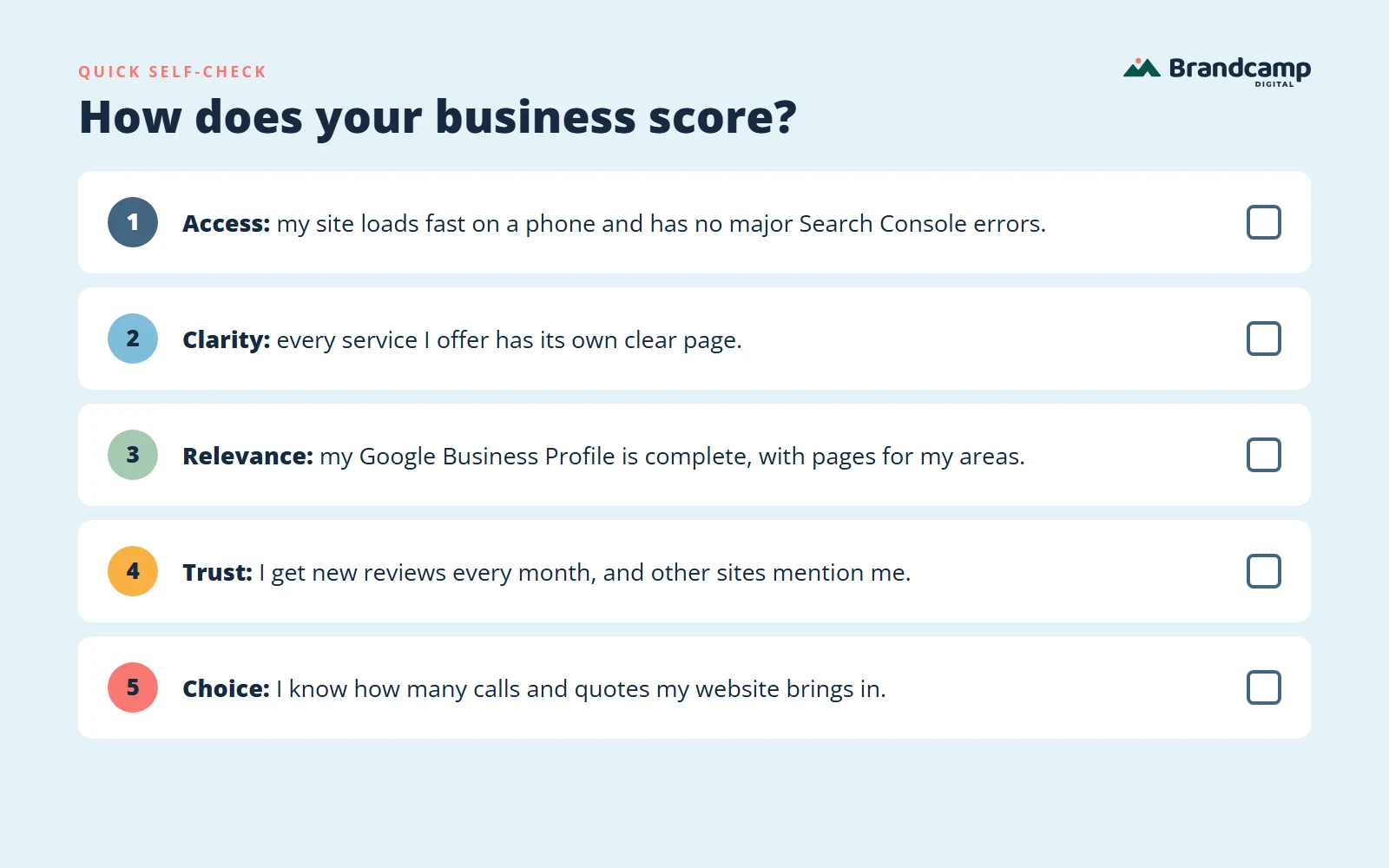
- Access: My website loads fast on a phone, and Google Search Console shows no major errors.
- Clarity: Every service I offer has its own page that explains it clearly.
- Relevance: My Google Business Profile is complete, and I have pages for the areas I serve.
- Trust: I get new Google reviews every month, and other websites mention my business.
- Choice: I know how many calls and quote requests my website brings in each month.
If you'd like a second opinion, ask us for a free Google and AI search visibility check. I'll show you how your business scores on each pillar and what I'd fix first.